By Gabe Dickens | City of Rusk, Carpenter County
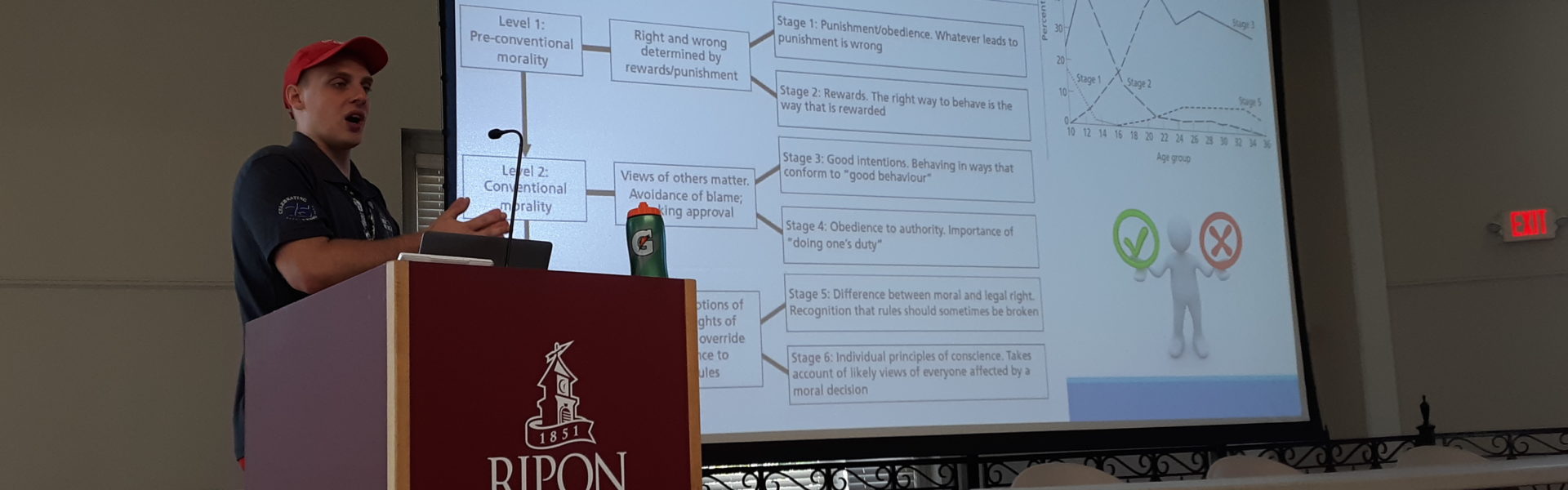
According to Bradley Pfeifer, the speaker during the discussion Personality Evolution and Morality this Monday at Badger Boys State, “The way we can express leadership as rising seniors focuses on ascribed personality; personality should be based on who we are including thoughts, feelings, moral beliefs and experiences.”
During the discussion, the group took frequent periods to separate into small groups and talk about their personality types as described in the presentation.
Ideas such as the Trait Theory and the Myers Briggs test, both used in psychology and studies of personality, were brought up by students and Pfiefer as discussion commenced.
Pfeifer described different personality types including assertive vs. turbulent, observant vs. intuitive, thinking vs. feeling, judging vs. prospecting and lastly, introvert vs extrovert. Pfeifer described how personality traits should be viewed as a spectrum rather than black and white and how our personalities are subject to change as we grow and develop.
Many teenagers for example are more stuck in the turbulent stage where many are subject to stress, self conscious, and reactionary. Pfeiffer said BBS is meant to force boys intro a more assertive position where leadership happens.
Pfeifer said the root of dichotomy arguments often evolves from people of two different personality types, that is, thinking vs feeling where one may come from a standpoint of truth and a competitive position where the other arguer comes looking for support and someone to talk to and share emotions with. Pfeifer noted that among females feeling personality types are more common vs males commonly have less empathetic thinking types.
Pfeifer explained that if one has a particular personality type compatible with a job they will be happier however these traits can be worked on to better fit a job.
A video was presented on how we can better argue, debate and be leaders.
This included avoiding fallacies like the straw man, or misrepresenting an opponent’s argument and arguing against an irrelevant point. Relying on outlier evidence or using a case less representative of the whole of evidence and Ad Hominem or attacking the opponent, not their argument were also discussed as ways to improve citizens skills.
For those at BBS it is important to think about these logical fallacies when in an argument for introspection and when viewing an opponent.
Pfeifer ended off on a latin quote stating, “age quod aquis,” or, “do what you’re doing,” meaning to pursue a goal and nothing else, and avoid distractions. And if you decide to drop an effort, there is nothing wrong with that.
Pfeiffer pointed out the, “sunken cost fallacy,” where one thinks one must invest time, money and energy into a goal and complete it where this is not a reality.
If a goal is unachievable, drop it and expend energy somewhere else more useful.